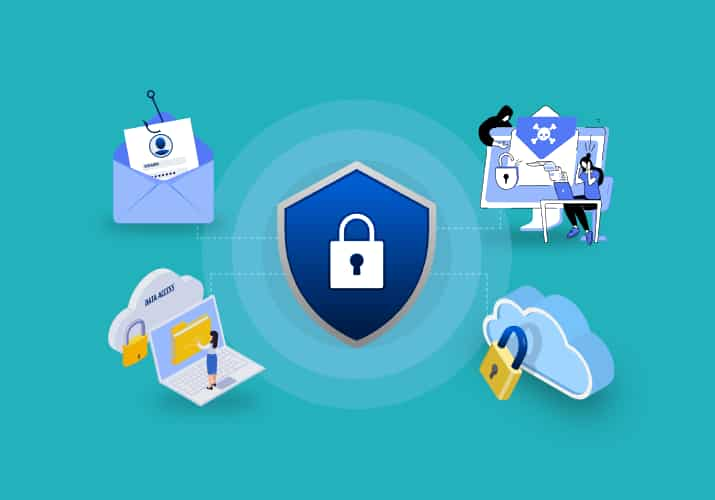
Cybersecurity is no longer just an IT issue. For most companies, it is now an operational, financial, legal, and reputational risk that can interrupt production, lock up systems, expose customer data, and trigger regulatory consequences. What makes the current environment especially difficult is that the biggest threats are not isolated; they reinforce one another. A phishing email can lead to credential theft, credential theft can enable ransomware, and a vendor weakness can become the entry point for a major breach.
The latest industry reporting shows that businesses are being hit from multiple angles at once. Verizon’s 2025 Data Breach Investigations Report highlights growing third-party exposure, more exploitation of vulnerabilities, and a notable rise in ransomware presence in breaches, while IBM’s 2026 threat reporting emphasizes exploitation of public-facing applications, identity-based attacks, and the security risks that expand alongside AI adoption. Taken together, these findings show that the modern attack surface is broader, more distributed, and harder to defend than it was only a few years ago.
1. Ransomware is still one of the most dangerous threats
Ransomware remains one of the most disruptive threats because it does not just steal information; it can halt operations, damage supply chains, and pressure executives into high-stakes decisions under time stress. Verizon says ransomware was present in 44% of all breaches analyzed in the 2025 DBIR, and it also notes that ransomware was linked to 75% of system-intrusion breaches covered in this year’s reporting.
What makes ransomware especially dangerous today is how it has evolved. Attackers increasingly combine encryption with data theft, extortion, and pressure tactics that target public reputation and business continuity. IBM’s threat overview also points to an increase in active ransomware groups compared with the prior year, which suggests that even when one tactic becomes less effective, the broader criminal ecosystem continues adapting.
For companies, the lesson is straightforward: ransomware is no longer just a malware problem. It is a resilience problem. Organizations need segmented networks, tested backups, rapid detection, identity protection, and incident response plans that assume attackers may already have access before the encryption phase begins. Verizon explicitly recommends MFA, patching, employee training, encryption, regular testing, and an incident response plan as core risk-reduction measures.
2. Stolen credentials and identity abuse
If there is one threat that cuts across almost every modern breach category, it is identity compromise. Attackers increasingly prefer to use valid credentials, stolen sessions, or compromised tokens because it allows them to bypass many traditional defenses and appear legitimate inside the environment. IBM states that security leaders must improve visibility into identity-based risks, and supporting reporting on IBM’s 2025 findings says 30% of intrusions handled by incident responders involved valid, compromised credentials.
Verizon’s DBIR points in the same direction. Its 2025 report page says 88% of breaches in the Basic Web Application Attacks pattern involved stolen credentials, showing just how central account compromise has become in common attack paths. This is why security leaders increasingly say identity is the new perimeter: once attackers obtain access that looks legitimate, lateral movement becomes much easier and detection becomes much harder.
This threat is bigger than passwords alone. Token theft, credential reuse, infostealer malware, and adversary-in-the-middle techniques can all undermine even organizations that think MFA alone is enough. For businesses, strong identity security now means phishing-resistant MFA, privileged access controls, session monitoring, anomaly detection, device trust, and fast revocation of exposed credentials.
3. Phishing and social engineering
Phishing remains one of the most common and effective attack methods because it targets human trust rather than technical weaknesses alone. Verizon’s 2025 DBIR page identifies phishing and pretexting as top causes of costly data breaches, and external analysis of the same report lists phishing among the leading methods used by threat actors to breach organizations.
The reason phishing remains so dangerous is that it often acts as the starting point for other attacks. A convincing message can steal passwords, deliver malware, capture session tokens, or persuade an employee to approve a fraudulent transaction. In that sense, phishing is less a single threat than an attack delivery system for many other threats.
AI is making this problem worse by helping attackers craft more convincing lures at scale. Cybersecurity industry reporting for 2026 consistently points to AI-enabled scams and synthetic content as a growing issue, and IBM’s 2026 page specifically notes that attackers are using AI to scale operations. For businesses, this means awareness training still matters, but it must be paired with technical controls such as secure email gateways, domain protection, browser isolation, and identity-based detections.
4. Third-party and supply-chain compromises
Many companies spend heavily defending their own perimeter but remain highly exposed through software suppliers, service providers, contractors, and cloud partners. Verizon’s 2025 DBIR says breaches linked to third-party involvement accounted for 30% of breaches, which was twice as much as the previous year. That is one of the clearest signals in current threat reporting that vendor risk is now a major front line rather than a secondary concern.
This category includes more than classic software supply-chain attacks. It also includes vendor credential exposure, exploitable dependencies, insecure integrations, outsourced operational weaknesses, and business interruptions tied to external providers. Reporting on the DBIR emphasizes that system intrusion accounted for the vast majority of third-party attacks, including ransomware, credential theft, phishing, and exploited vulnerabilities.
For companies, the practical implication is that cybersecurity can no longer be assessed only internally. Vendor due diligence, continuous third-party monitoring, software bill of materials practices, access minimization, and contract-level security requirements are now essential. A company may have strong internal controls and still suffer a major incident because a partner became the weak link.
5. Exploitation of vulnerabilities
Unpatched or misconfigured internet-facing systems remain one of the most reliable ways for attackers to gain initial access. Verizon’s 2025 DBIR highlights an increase in attackers exploiting vulnerabilities to gain initial access and cause security breaches compared with the previous year, and it also notes that only a portion of perimeter-device vulnerabilities were fully remediated while many remained unresolved.
IBM’s 2026 threat page reinforces the same concern. It highlights year-over-year growth in the exploitation of public-facing software or system applications and warns that organizations need continuous, proactive approaches to identifying weaknesses across both on-premises and cloud environments. The page also stresses secure code review, misconfiguration detection, dynamic testing, and scanning for missing patches.
This is one of the most important points for executives because it sounds technical but is really managerial. Vulnerability exploitation often succeeds not because defenders lack tools, but because patching is delayed, asset inventories are incomplete, ownership is unclear, or business units fear downtime. In other words, weak cyber hygiene remains one of the biggest business risks in cybersecurity.
6. AI-related threats and the expanding attack surface
AI is creating a new security layer that companies must manage carefully. IBM’s 2026 threat page says agentic AI has introduced new risks and amplified old ones, and it recommends strong AI authentication, tighter access controls, protection of AI service credentials, and monitoring for abnormal access patterns. It also says model governance is needed to evaluate bias, drift, accuracy, and inappropriate behavior.
This matters because companies are rapidly deploying AI assistants, copilots, APIs, and autonomous tools into customer support, marketing, coding, search, and internal workflows. Every new AI service can create fresh exposure through insecure plugins, leaked API keys, weak prompt-layer protections, data leakage, over-permissioned integrations, or compromised model pipelines. The threat is not only that attackers use AI, but also that businesses expose themselves through rushed AI adoption.
At the same time, defenders are also using AI to improve response. IBM highlights autonomous security operations centers and agentic AI for threat hunting and remediation, showing that AI is not just a threat multiplier for attackers but also a force multiplier for defense. The challenge for businesses is to adopt AI with governance and not treat it as a shortcut around security fundamentals.
What this means for companies
The biggest cybersecurity threats companies face today are interconnected: ransomware, identity abuse, phishing, third-party exposure, vulnerability exploitation, and AI-related risk all feed into one another. The common thread is that attackers succeed when they find gaps in visibility, speed, governance, and access control rather than when they rely on brute force alone.
That is why the strongest security programs now focus on a few essentials. They reduce unnecessary access, harden identity systems, patch aggressively, monitor vendors, train employees, and rehearse incident response before a crisis happens. In today’s environment, the companies that handle cyber risk best are not the ones chasing every headline threat individually; they are the ones building resilience across the full attack chain.